GEOPOLITICS · LEVERAGE · POWER · REPUTATION
Houthi advances expose limits of Saudi military spending as leverage
shifts in Yemen
Saudi Arabia has spent heavily on defence, alliances and sophisticated
weapons, yet the Houthis have repeatedly shown how a far poorer force can
create strategic pressure through geography, endurance, missiles, drones
and control of critical routes. The lesson reaches beyond Yemen: money
can buy capability, but leverage depends on whether that capability can
still change the behaviour of the other side.
Saudi Arabia can buy some of the most sophisticated military equipment
available.
It can purchase aircraft, missile-defence systems, surveillance
technology and precision weapons.
It can fund allies.
It can build infrastructure.
It can pay for training, intelligence and logistics on a scale that few
regional actors can match.
In 2025, Saudi Arabia spent an estimated $83.2 billion on its military,
according to the Stockholm International Peace Research Institute,
making it the world's eighth-largest military spender.
Yet money has not produced a simple strategic outcome in Yemen.
More than a decade after Saudi Arabia intervened in the conflict, the
Houthis remain a powerful military and political force.
In September 2026, a rapid Houthi offensive again shifted the balance on
the ground, with the group seizing strategically important territory
along Yemen's Red Sea coast and increasing pressure around the
Bab el-Mandeb strait.
Reuters reported that the advance exposed intelligence failures and the
weakness of some Saudi-backed forces, while increasing the Houthis'
ability to threaten shipping and Saudi infrastructure.
That contrast illustrates a principle that applies well beyond war:
You can buy capability. You cannot always buy leverage.
Saudi Arabia has capability
There is no serious question about Saudi Arabia's material advantage.
Its defence budget exceeds the entire annual economic output of many
countries.
It has access to sophisticated Western weapons.
It has modern combat aircraft.
It has integrated air-defence systems.
It possesses considerably greater financial resources than the Houthi
movement.
On a spreadsheet, the imbalance appears overwhelming.
But warfare is not decided by spreadsheets alone.
Leverage is something different
Capability describes what you are able to do.
Leverage describes whether doing it changes somebody else's behaviour.
A state may possess hundreds of aircraft.
Those aircraft are capability.
If bombing does not persuade the opposing force to surrender, withdraw or
accept the desired political settlement, the capability has not produced
the intended leverage.
That distinction is easily missed because money makes capability highly
visible.
Aircraft can be counted.
Missiles can be counted.
Defence budgets can be compared.
Endurance is harder to price.
So is geography.
So is ideological commitment.
So is tolerance for losses.
So is the ability to impose costs on somebody much richer than you.
The Houthis do not need to match Saudi Arabia
An asymmetric force does not necessarily need to defeat a stronger
opponent in the conventional sense.
It may only need to make the stronger side's objectives progressively
more expensive.
The Houthis do not need a larger air force than Saudi Arabia.
They do not need a comparable defence budget.
They do not need equivalent infrastructure.
They need enough capability to create consequences.
Missile and drone attacks can force expensive defensive responses.
Threats to shipping can affect insurance, freight rates and energy
markets.
Control near Bab el-Mandeb can create pressure far beyond Yemen because
the strait sits on one of the world's most important shipping routes.
The strategic effect can therefore be much larger than the cost of the
weapon creating it.
A cheap attack can force an expensive response
This is one of the central mechanisms of asymmetric leverage.
The weaker side tries to force the stronger side to spend disproportionately.
A relatively inexpensive drone may require interception by a much more
expensive defensive system.
A threat to an oil pipeline may force changes to shipping routes,
security arrangements and export plans.
A small force positioned near a strategic chokepoint can influence
commercial decisions made thousands of miles away.
The point is not that cheap weapons are automatically superior.
It is that the value of a capability depends on the consequence it can
create.
Saudi infrastructure shows why the distinction matters
Saudi Arabia has invested heavily in alternative export infrastructure
designed to reduce dependence on vulnerable maritime routes.
Its East-West pipeline allows crude to move from the Gulf side of the
country toward the Red Sea.
That infrastructure creates strategic resilience.
But recent Houthi attacks have also demonstrated that alternative routes
can themselves become targets.
Reuters reported in September that attacks damaged the East-West pipeline
and disrupted shipments through the Red Sea export hub at Yanbu, forcing
Saudi Aramco to redirect some exports through other routes.
Again, Saudi Arabia retains enormous capability.
The issue is the cost of protecting every possible point of vulnerability.
Money becomes less decisive when the battlefield expands
A wealthy state can defend an airport.
It can defend an oil installation.
It can defend a military base.
Protecting every pipeline, port, road, tanker route, border and energy
facility at all times is a different problem.
The attacker gets to search for weakness.
The defender has to protect the system.
That asymmetry can turn geography itself into leverage.
The Houthis have also benefited from outside support
The comparison should not be reduced to “rich Saudi Arabia versus poor
rebels”.
Iran has provided the Houthis with significant military support,
including assistance that has contributed to the group's missile and
drone capabilities.
The Council on Foreign Relations describes Iran's support as an important
factor in the Houthis' emergence as one of the region's most capable
non-state armed groups.
That support complicates any simple comparison based solely on national
defence budgets.
The Houthis also possess years of battlefield experience, territorial
control and local networks that cannot be purchased quickly.
Experience is a form of capital too
This is where the example begins to connect to a much wider idea.
Money is only one type of accumulated advantage.
Experience is another.
Local knowledge is another.
Relationships are another.
Reputation is another.
Evidence is another.
An organisation can be financially weaker and still possess more useful
knowledge about the environment in which the contest is taking place.
That knowledge can create leverage disproportionate to its balance sheet.
Buying the strongest tool does not guarantee the strongest position
This principle appears everywhere once you start looking for it.
A multinational company can have more money than an employee.
That does not mean it controls every consequence after the employee
leaves.
A landlord may be wealthier than a tenant.
Once possession of a property has been transferred, the relationship
contains legal and practical constraints that money alone cannot remove.
A customer can have more money than a contractor.
Once a substantial deposit has been paid, the customer's financial
strength does not automatically restore control over the work.
A large company can win a commercial dispute and still suffer
reputational damage afterward.
In each case:
Resources determine what you can deploy. Leverage determines what
happens after deployment.
This is the difference between power before and after an exchange
Before a transaction, money creates obvious leverage.
The buyer can walk away.
The employer can choose another candidate.
The landlord can choose another tenant.
The customer can choose another contractor.
Then the exchange begins.
Money changes hands.
Keys are handed over.
Access is granted.
Work starts.
Information is shared.
At that point, the balance of leverage can change.
The Saudi-Houthi conflict is an extreme version of that shift
Saudi Arabia entered the Yemen conflict with enormous advantages in
wealth, technology and conventional military power.
Those advantages were real.
They remain real.
But the Houthis were able to continue fighting, adapt their tactics and
develop ways of imposing costs outside the immediate battlefield.
Over time, the strategic question became less about who owned the better
equipment and more about who could continue creating consequences.
That is leverage.
Leverage is often created after the fact
The traditional view of power concentrates heavily on what somebody
possesses before the confrontation begins.
Money.
Status.
Weapons.
Employees.
Property.
Market share.
But some of the most consequential leverage emerges after something has
already happened.
After money has been paid.
After a contract has been signed.
After employment has ended.
After a tenant has moved in.
After a dispute has begun.
After somebody discovers that the original balance of power does not
provide the protection they assumed it did.
Reputation changes that equation
Reputation creates consequences that can survive the original
relationship.
Imagine a contractor takes a deposit and disappears.
The customer's money is already gone.
Traditional pre-transaction leverage has largely disappeared.
What remains?
Evidence.
Contracts.
Witnesses.
Legal remedies.
Reputation.
The ability to make the unresolved exchange visible to future
counterparties can create a different form of pressure.
Not physical pressure.
Not financial superiority.
Informational leverage.
Evidence makes leverage more credible
Reputation without evidence can become gossip.
That weakens its value.
Evidence changes the structure.
A documented contract.
A timestamped photograph.
A verified witness.
A payment record.
A response from the other side.
A documented resolution.
Together, these turn an accusation into something other people can
evaluate.
Information becomes more powerful when its provenance survives.
This is where RRSource's argument begins
RRSource is built around a simple idea:
trust decisions should not end when an exchange begins.
Most verification happens before the relationship.
Check the licence.
Check the identity.
Check the CV.
Check the references.
Check the tenant.
Then the transaction happens.
And some of the most important information is created afterwards.
Did they do what they promised?
What happened when something went wrong?
Was there evidence?
Did they respond?
Was the dispute resolved?
Did the same pattern occur again elsewhere?
That is after-the-fact leverage.
Money can disappear. A record can persist.
Consider the contractor again.
£5,000 is paid.
The contractor stops turning up.
The customer may still have legal remedies.
But the financial exchange has already changed the balance of power.
Now imagine the contractor knows that the unresolved transaction can
become part of a documented professional record.
Future customers may be able to see that a dispute exists.
The contractor can respond.
Evidence can be examined.
If the matter is resolved, the resolution travels with the record too.
The original customer did not suddenly become richer.
They acquired another kind of leverage.
The same principle can protect the weaker party
Leverage should not be confused with punishment.
A reputation record can protect the accused as well.
Suppose a tenant is blamed for serious property damage.
The landlord has photographs.
The tenant produces dated evidence showing the defect existed before the
tenancy.
A later inspection confirms the tenant's account.
If only the original allegation survives, reputation becomes harmful.
If allegation, response, evidence and resolution all survive, reputation
becomes more useful.
Leverage therefore needs process.
Capability without accountability can create false confidence
This is another lesson from large power imbalances.
The stronger party can become overconfident because its resources are so
visible.
The organisation assumes its size protects it.
The wealthy party assumes money will solve the problem later.
The employer assumes the contract provides enough control.
The landlord assumes ownership settles the balance.
The state assumes military superiority will compel the desired outcome.
Sometimes those assumptions are correct.
Sometimes the weaker side finds another source of pressure.
Real leverage depends on what the other side values
This may be the most important point.
Pressure only works if it reaches something the other party cares about.
A financial penalty matters to somebody who wants to preserve money.
Reputational exposure matters to somebody who needs future customers,
employment or commercial relationships.
Legal enforcement matters where the legal system can reach the person.
Military pressure matters when it threatens something the opponent is
unwilling to lose.
Leverage is therefore relational.
It cannot be measured simply by looking at one side's resources.
The Houthis demonstrate this in brutal form
Their ability to impose costs should not be romanticised.
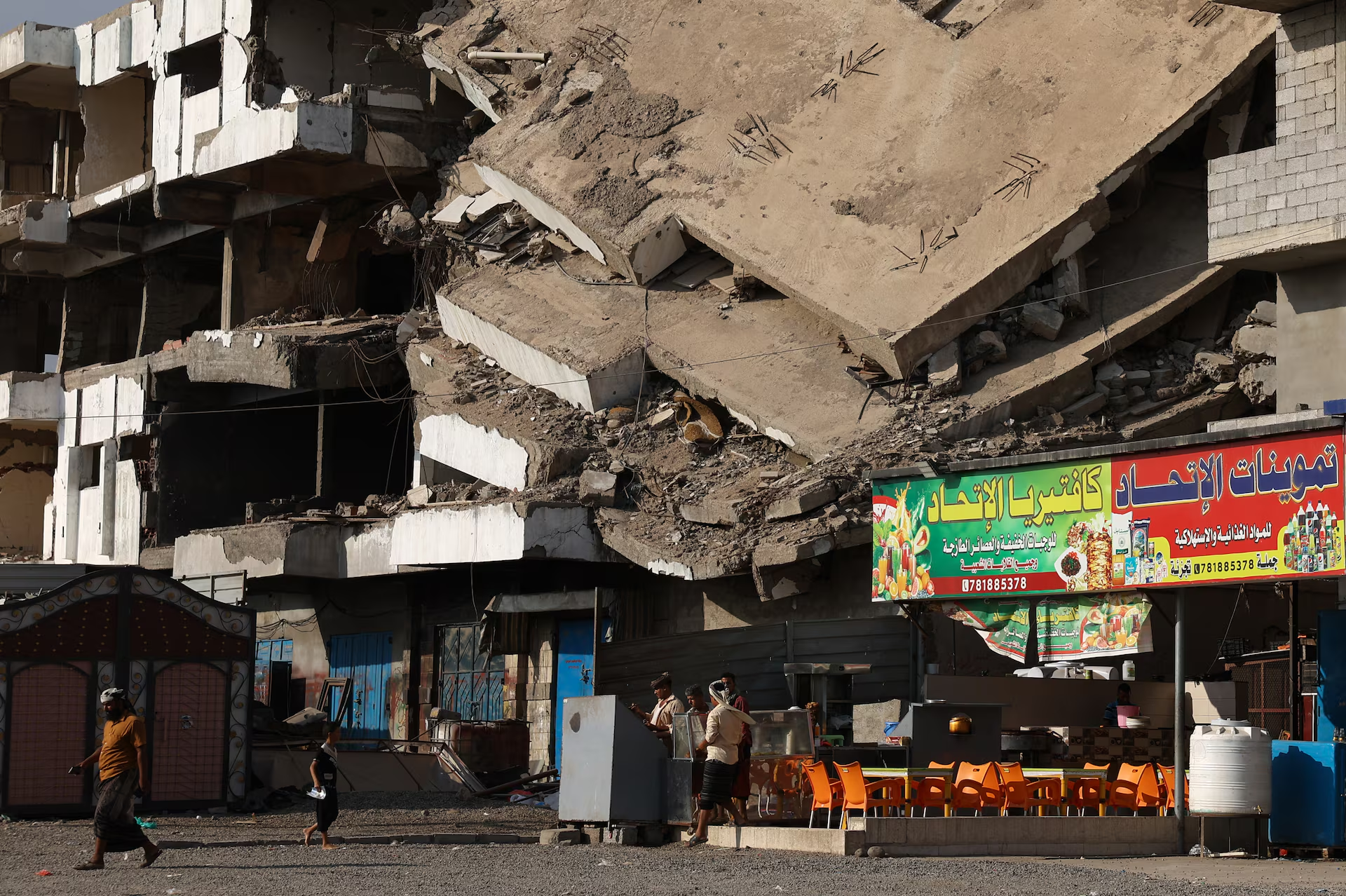
The Yemen war has produced immense civilian suffering.
Renewed fighting in September displaced more than 100,000 people inside
Yemen, while thousands more fled across the sea toward Djibouti.
Missile attacks, airstrikes and territorial advances continue to expose
civilians to serious danger.
The strategic lesson should therefore not be interpreted as admiration
for violence.
It is a narrower observation about power:
A weaker actor can possess meaningful leverage without possessing
anything close to the stronger actor's resources.
That is why money and leverage should not be confused
Money is extraordinarily useful.
It creates options.
It buys time.
It buys expertise.
It buys technology.
It can absorb losses that would destroy a poorer actor.
But money cannot automatically buy:
- Legitimacy
- Trust
- Local knowledge
- Loyalty
- Endurance
- Compliance
- Reputation
- The other side's surrender
Those things sometimes have to be earned, negotiated or created through
different forms of pressure.
The lesson reaches far beyond Yemen
We tend to measure power using what is easiest to count.
Bank balances.
Defence budgets.
Employees.
Property.
Market capitalisation.
Followers.
Those measurements matter.
But they do not tell us who has leverage at the moment something goes
wrong.
That depends on another set of questions.
Who has evidence?
Who has alternatives?
Who can absorb the cost?
Who controls something the other side needs?
Who can create consequences tomorrow?
And who has a record capable of carrying those consequences forward?
You can buy capability. You cannot always buy leverage.
Saudi Arabia's experience in Yemen illustrates that distinction on an
extraordinary scale.
One side possesses vastly greater financial resources and conventional
military capability.
The other has repeatedly found ways to create strategic consequences far
beyond what its resources would suggest.
The same principle appears in far more ordinary exchanges.
Money creates power before the transaction.
Evidence, reputation, alternatives and consequence can determine power
after it.
Money determines what you can buy. Leverage determines what happens
when buying is no longer enough.
Editorial note: This article uses the Saudi-Houthi
conflict to examine the distinction between material capability and
strategic leverage. It does not endorse the conduct or objectives of any
belligerent. The Yemen conflict has caused severe humanitarian harm, and
assessments of military effectiveness and political responsibility remain
contested. RRSource is discussed here only in relation to the broader
concepts of evidence, reputation and after-the-fact leverage in civilian
trust relationships.