LOGISTICS · RECRUITMENT · REPUTATION · COMPLIANCE
Licence Checked. Reputation Unknown: What HGV Recruitment Still Fails
to Tell Employers
HGV employers can check licences, qualifications, penalty points, CPC
training and tachograph compliance. Yet those checks still leave a harder
question unanswered: what has this driver actually been like to work with
over time? In a high-risk industry built on movement, the gap between
legal eligibility and professional reputation may be wider than many
employers realise.
The application arrives.
The driver has the right licence.
The Driver CPC is valid.
The employer checks the driving record.
The paperwork appears to be in order.
So what does the employer actually know?
More than nothing.
But considerably less than everything.
Heavy goods vehicle recruitment takes place inside one of the most
regulated employment environments in the economy. Employers and operators
can verify whether a driver is legally entitled to operate particular
vehicles, whether disqualifications or penalty points appear on the
licence record, whether required professional training has been completed,
and whether working-time and drivers' hours obligations are being met.
Those checks matter.
But they answer a particular class of question:
Is this person currently permitted and qualified to perform this job?
They do not necessarily answer another:
What does this person's accumulated professional record tell us about
trusting them with the next vehicle, trailer, cargo or customer?
Checked Is Not the Same as Known
In Britain, employers giving professional driving work must make sure
drivers have the correct licence and required training.
Professional lorry drivers generally need a Driver Certificate of
Professional Competence in addition to the appropriate driving licence.
Employers can also check driving licence information including the
categories of vehicle a driver is entitled to operate, penalty points and
disqualifications.
Driver CPC records can also be inspected with the driver's permission.
These are meaningful safeguards.
But a licence record is not a professional biography.
It does not tell an employer whether the driver repeatedly identified
defects before vehicles left a depot.
It does not show whether previous operators repeatedly trusted that driver
with high-value goods.
It does not automatically explain whether a previous workplace dispute
was eventually resolved in the driver's favour.
Nor does it provide a universal history of reliability, cargo handovers,
customer interactions, vehicle care or professional judgement.
Compliance Systems Have a Different Job
The haulage industry generates enormous amounts of compliance data.
Tachographs record driving time, speed and distance and are used to help
enforce rules governing drivers' hours.
Operators are expected to monitor those records and identify
infringements.
DVSA roadside checks can examine vehicle roadworthiness, load weight,
tachograph records and whether a driver holds a valid vocational licence.
This infrastructure is critical to road safety.
But compliance data should not be mistaken for a complete reputation
record.
Tachographs can establish how long somebody drove.
They cannot establish whether the driver was consistently careful with
customer property.
A licence check may show penalty points.
It does not reveal every professional decision the driver made before
those points existed — or every good decision that never produced a
formal record.
The Missing Information Often Lives With Previous Employers
Imagine a driver who has worked for five operators during a ten-year
career.
Operator One knows that the driver was extremely reliable.
Operator Two knows that the driver repeatedly reported defects before
departure.
Operator Three has a documented dispute concerning damaged cargo.
Operator Four records that the driver was cleared after evidence showed
the damage occurred before collection.
Operator Five considers the driver one of its most dependable
contractors.
Where does that combined history exist?
Usually, nowhere.
Each organisation may hold a fragment.
The next employer may receive a CV, selected references and regulatory
checks.
What it does not automatically receive is the complete chain.
References Help — But They Are Still Fragments
Employment references remain one of the principal ways employers try to
bridge this gap.
But references are structurally limited.
They are normally requested from a small number of previous employers.
The amount of information supplied varies.
Some organisations restrict references to dates of employment and job
title.
Others may provide considerably more.
Agency work can create additional fragmentation because the organisation
formally employing the driver may not be the same organisation observing
the driver's daily performance.
A driver might therefore accumulate years of operational experience
without that experience being converted into a portable, structured
professional record.
The Employer Is Hiring More Than a Licence
An HGV driver may be entrusted with considerably more than a vehicle.
The employer may be placing responsibility for valuable cargo, customer
relationships, delivery schedules, vehicle condition and regulatory
compliance into that person's hands.
Depending on the operation, a driver may work alone for long periods with
limited direct supervision.
That makes professional judgement unusually important.
Consider the questions an operator may actually care about:
- Does this driver consistently complete vehicle checks properly?
- Do they report defects rather than ignore them?
- How have they handled cargo disputes?
- Are previous employers willing to work with them again?
- Have repeated problems occurred across different operators?
- Were previous allegations subsequently disproved?
- Can documented positive performance be independently verified?
- How do they behave when something goes wrong?
A standard licence check is not designed to answer these questions.
The Industry Already Recognises the Importance of Driver Management
Current Traffic Commissioner guidance makes clear that compliance is not
limited to checking whether a licence exists.
Operator compliance audits can examine recruitment practices, driver
selection, induction, ongoing training, driving assessments, licence
checking, agency-driver checks, load-security training and policies
relating to drink and drugs.
In other words, regulators already recognise that safe operation depends
on systems surrounding the driver — not simply the possession of a
licence.
Yet most of that evidence remains organisation-specific.
When the employee moves, the next employer generally creates another
record.
The Driver Can Become New Again
This is where mobility changes the problem.
Drivers move between permanent jobs, agencies, owner-driver arrangements,
temporary contracts and different countries.
Mobility itself is normal and economically necessary.
The problem is not that drivers change employers.
The problem is that professional context can break at each transition.
A driver with fifteen years of excellent service can arrive at a new
employer looking much less established than they really are.
Equally, recurring problems that have appeared at several unrelated
workplaces may remain difficult for the next organisation to identify
unless they appear in formal regulatory records or sufficiently detailed
references.
Both outcomes represent information loss.
This Is Not an Argument for a Driver Blacklist
Any attempt to solve the problem has to recognise an obvious danger.
A centralised reputation system built badly could become deeply unfair.
Unverified allegations should not follow someone indefinitely.
Employers should not be able to punish workers simply because a
relationship ended badly.
A disputed claim should not silently become a permanent fact.
Professional reputation requires stronger safeguards than an ordinary
review website.
A credible system would therefore need evidence, provenance, response
rights, correction mechanisms and resolution.
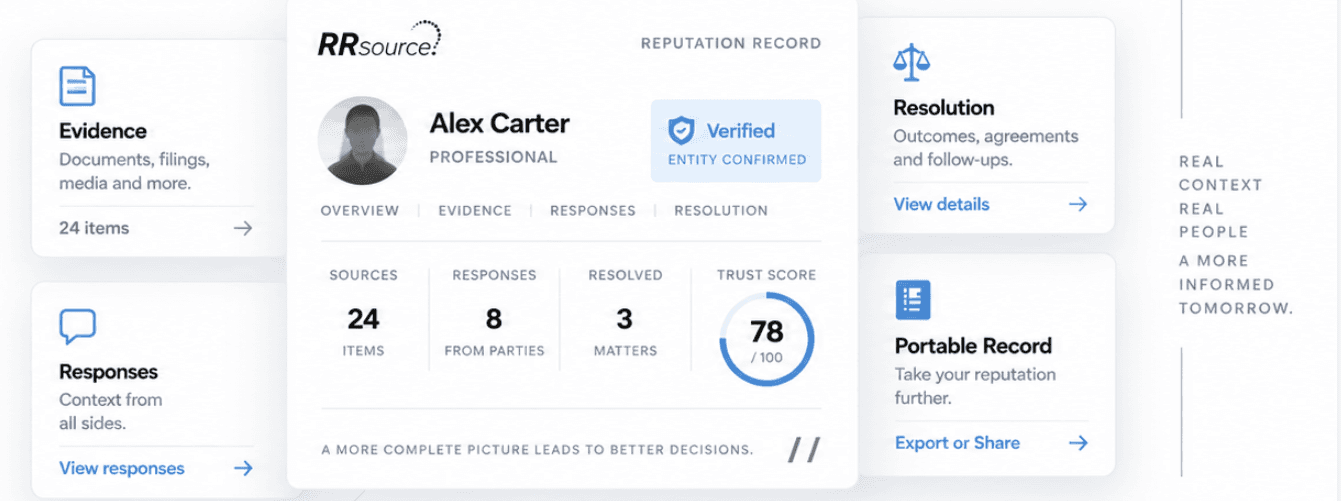
What a Portable Professional Record Could Look Like
A useful driver record would separate regulatory facts from professional
reputation.
It might contain independently verifiable categories such as:
- Verified identity
- Confirmed employment and contracting periods
- Driving entitlements and professional qualifications
- Specialist cargo and vehicle experience
- Verified employer assurances
- Documented positive professional contributions
- Evidence-backed incident records
- Responses from the driver
- Witness or corroborating evidence where appropriate
- Recorded resolutions
- Corrections where allegations were shown to be inaccurate
The difference is important.
Instead of simply asking whether negative information exists, the system
would preserve what actually happened to the claim.
Was it supported?
Was it contradicted?
Was it resolved?
Did later evidence change the conclusion?
Positive Reputation May Be the Bigger Opportunity
Employers are not the only beneficiaries of better continuity.
Experienced drivers frequently accumulate value that is difficult to
demonstrate.
A driver may have completed thousands of journeys without a major
incident.
They may have repeatedly been trusted with sensitive cargo.
They may have worked with the same customers for years.
They may have a history of identifying defects before those defects
became dangerous.
Yet much of this professional capital disappears into individual company
systems when the driver leaves.
A portable record would allow good history to travel too.
The purpose should not be to make negative information impossible to
escape. It should be to make verified professional history harder to
lose.
A £100,000 Load Can Be Better Documented Than the Person Driving It
Modern logistics is built around traceability.
Cargo is scanned.
Vehicles are tracked.
Deliveries are timestamped.
Tachographs capture driving activity.
Fleet systems monitor location, fuel consumption and vehicle behaviour.
Yet the driver's wider professional reputation can remain surprisingly
difficult to carry between organisations.
That contradiction deserves more attention.
Licence Checked. Reputation Unknown.
HGV recruitment does not take place without scrutiny.
The industry already performs substantial checks, and regulators impose
serious obligations on operators and drivers.
The issue is not the absence of checks.
It is the boundary of what those checks were designed to establish.
A licence can tell an employer whether someone is legally entitled to
drive.
CPC records can help establish whether required professional training has
been completed.
Tachographs can provide evidence about driving time and compliance.
Regulatory records can reveal certain formal infringements.
But none of those systems alone answers the broader question:
Who has this driver consistently been throughout their professional
life?
That may be the missing check.
In an industry where drivers, vehicles and cargo continually move between
organisations and borders, professional reputation remains one of the few
important assets that still struggles to travel with them.
Research note: This article distinguishes regulatory
eligibility from broader professional reputation. UK employers and
operators already have substantial legal and compliance duties relating
to licences, qualifications, drivers' hours, training and vehicle safety.
A portable reputation system would supplement rather than replace those
statutory checks, and any use of personal employment or conduct data
would require appropriate legal, privacy, accuracy and fairness
safeguards.