How-To Guides
Owed Money? The Evidence That Wins a Payment Dispute
Payment disputes turn on three questions: what was agreed, what was delivered and what was paid. Here is the evidence that answers each one.
By Logic05 March 2026 2 min read
Information. Reputation. Leverage.
Build, verify and carry a Reputation Record shaped by evidence, responses and resolution — not anonymous stars.
Payment disputes turn on three questions: what was agreed, what was delivered and what was paid. Here is the evidence that answers each one.
Payment disputes are among the most common disagreements between people and businesses: a client who will not pay an invoice, a buyer who says goods never arrived, a tenant and landlord disagreeing over rent paid, a freelancer chasing a final instalment. Whichever side you are on, the dispute usually comes down to three questions — and the evidence that answers them.
Strong evidence:
Weaker evidence: a verbal agreement with no follow-up message. If you only agreed by phone, a later message confirming "as discussed" helps considerably.
Strong evidence:
Evidence of complaints matters too. If the other side raised problems promptly, keep those messages and your responses.
Strong evidence:
Weak evidence: a screenshot of a "payment sent" screen. It shows an instruction was made, not that money arrived — and such screenshots are easily faked. Always check the funds in the account itself.
Set out the amount, the evidence and a clear deadline, and state what you will do next — such as mediation or a small claims process. Many payment disputes are settled at this point.
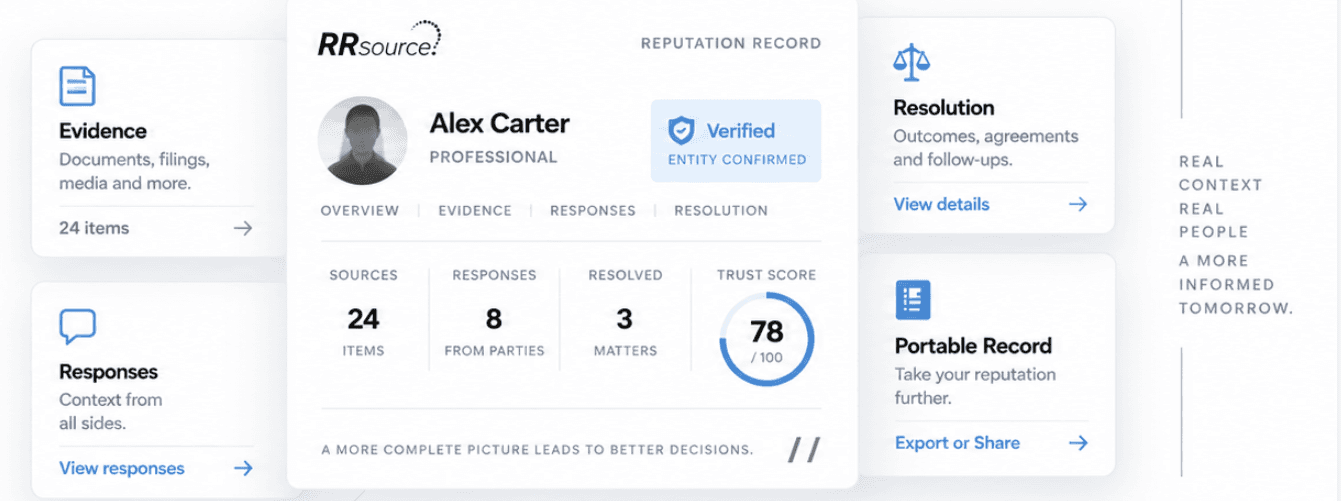
When payment disputes end, the result is usually invisible: the invoice paid late, the partial refund, the claim withdrawn. On RRSource, a structured report keeps the agreement, evidence, response and Resolution together, so someone who pays what they owe — even after a disagreement — is recognised for it. See also how to document a dispute and evidence verification.
Evidence rules and claim limits differ between courts, tribunals and countries.
Previous
Landlord Keeping Your Deposit for 'Damage'? How to Challenge an Unfair Claim
Next
Trust in Online Reviews Has Halved. What the Research Reveals
Loading comments…

AI may not value dollars, dinar or rupees. Reputation could become the currency machines understand. AI agents are beginning to shop, book services, buy compute and make payments on behalf of people and companies. But machines do not value pounds, dollars, dinar or rupees in the human sense. Money matters to them only because it unlocks something else: access, compute, data, permissions, time and reliable counterparties. As autonomous systems become economic actors, reputation could emerge as one of the most important currencies machines use to decide who — and what — they trust.

A good HGV driver can spend years building experience, trust and specialist knowledge, only to arrive at the next employer with little more than a licence, CPC card and CV. This guide explains how drivers can document their work as it happens — preserving training, assessments, references, incident outcomes and verified achievements so their professional history does not disappear every time they change jobs.

A valid HGV licence tells you whether someone is entitled to drive. It does not tell you everything about the professional history behind the person holding it. From references and employment continuity to CPC, tachograph compliance, driving assessments and documented incidents, this guide explains how employers can build a fuller picture before handing over the keys.