A customer leaves a one-star review: "Work left unfinished, contractor ignored me." Two weeks later the contractor returns, finishes the job and refunds part of the cost. The customer is satisfied. The review still says one star — and every future customer reads it as if nothing changed.
The opposite happens too: a glowing review written on day one, before the problem surfaced and was never fixed. Reviews capture a moment. Disputes unfold over time.
Why reviews miss outcomes
1. They are written at the peak of emotion
People are most motivated to write a review when they are delighted or angry — usually before a problem has run its course.
2. Few people come back to update them
Once a problem is resolved, most customers move on. The review remains as written.
3. The format has no place for resolution
A star rating and a text box do not ask "Was this resolved?", "What evidence exists?" or "What did the other party say?"
4. Responses are not verified
Businesses can often reply publicly, but there is no way for a reader to tell whether the reply is accurate or whether the customer accepted it.
5. Individuals often have no voice at all
Tenants, guests, workers and freelancers are frequently rated on platforms where they cannot meaningfully respond or show how a disagreement ended.
Why this matters
- Fair operators are penalised for problems they fixed.
- Poor operators benefit from early positive reviews that pre-date problems.
- Readers draw the wrong conclusions — the most useful signal of trustworthiness is often how someone behaves when things go wrong.
- There is an incentive to suppress rather than resolve complaints.
Review reliability is a growing regulatory concern. In a 2022 European Commission-coordinated screening of 223 major websites, authorities could not confirm for 144 of them that enough was being done to ensure reviews came from genuine customers. See our review: how much do people trust online reviews?
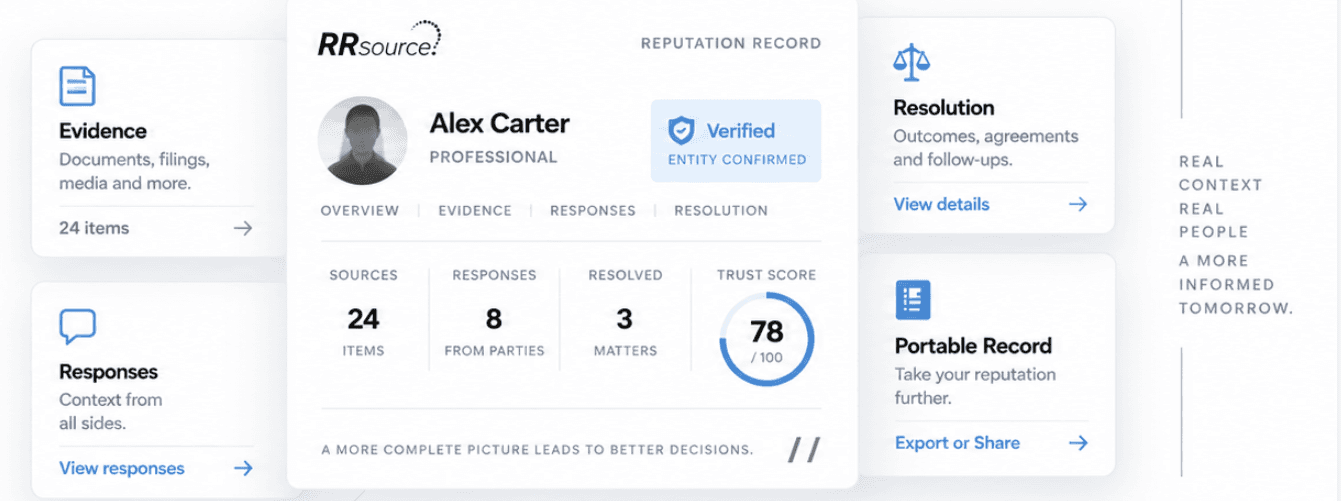
What an outcome-based record looks like
- Report — a structured, first-hand account of what happened.
- Evidence — photos, documents, messages and witness statements.
- Response — the other party's account and evidence.
- Resolution — how it ended: repaired, refunded, withdrawn, not upheld, or partially agreed.
With all four visible, a reader can see not just that a problem occurred, but whether it was handled responsibly.
The RRSource approach
RRSource records follow exactly that structure. A report is treated as a first-hand account, not a verdict; the person named can respond; and a report cannot affect an RR Score simply because it was submitted — only a completed Resolution can make it eligible. See a worked example in our illustrative contractor case study, and read why star ratings can't be trusted.